June 2026
Three Documents. One Transaction. Not a Simple Sale.
Georgia Capital Cannot Separate the SPA from the MOU
By Natia Janashia
Georgia Capital wants to reduce the 2019 transaction to one sentence: 'We paid GEL 30 million.' Their entire public narrative depends on separating the transaction documents. This article shows why that narrative fails — using their own documents.
In May 2019, Davit Tsetskhladze and I entered into a transaction with Georgia Capital concerning the British-Georgian Academy. The transaction was not a simple share sale — it was an investment transaction. The sale of shares, the investment commitments, the land arrangements, and the protections for our remaining 30% stake were all part of one overall deal. This is not merely my interpretation — it is confirmed by the transaction documents themselves. Three documents must be read together: the BGA/BIST Business Model, the Memorandum of Understanding, and the Share Purchase Agreement. Together, they show that Georgia Capital cannot rely on the Share Purchase Agreement while ignoring the MOU and Business Model that formed the basis of the transaction.
1. The Business Model: Okrokana Land Valued at Zero
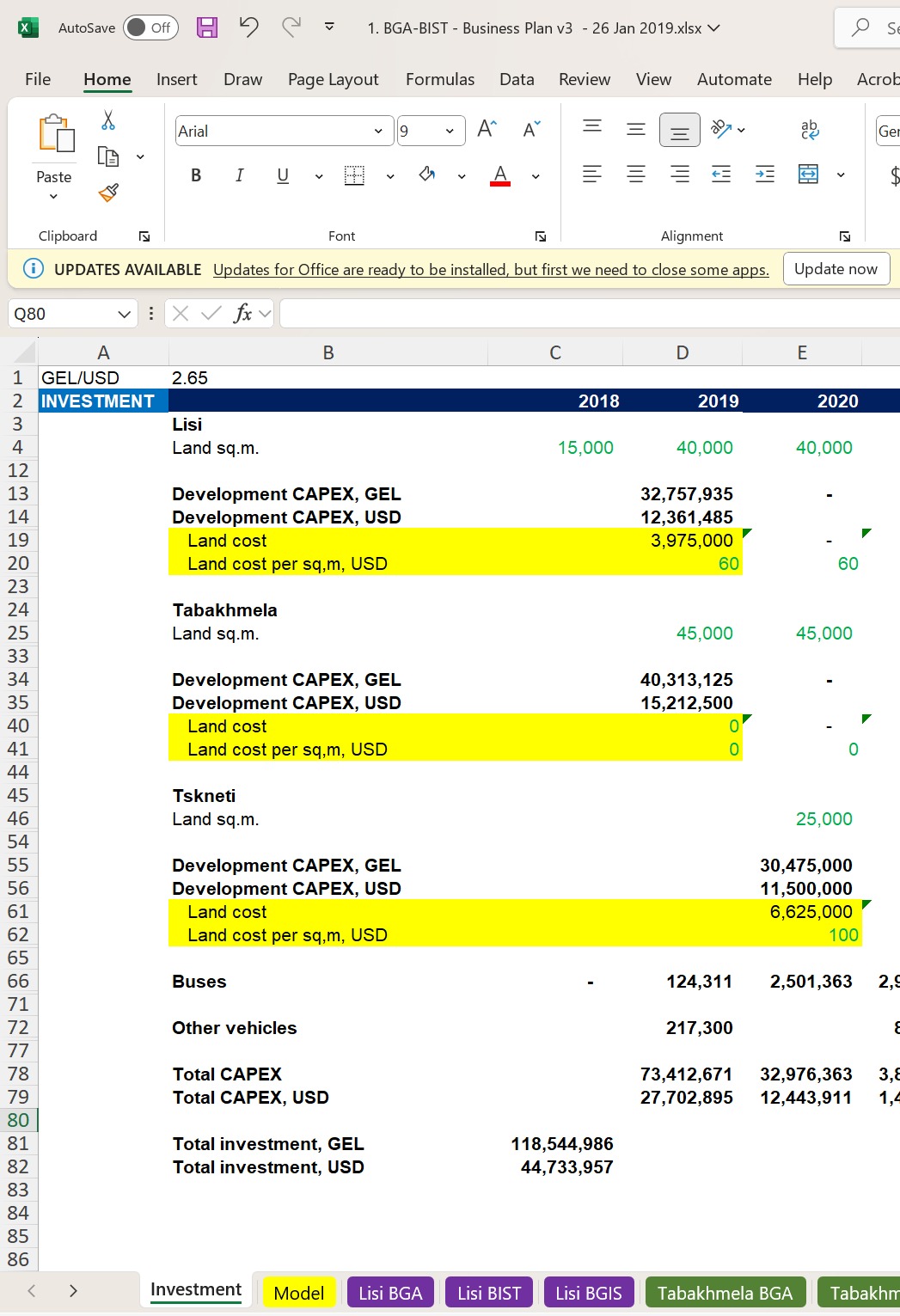
The Business Model was part of the transaction framework, showing how the development of the schools was to be financed. Most importantly, it valued the Okrokana / Tabakhmela land at zero. That matters because the total investment figure of approximately GEL 88.2 million was calculated on exactly that basis. The land's nil value was not an afterthought — it was built into the Business Model itself, which formed the basis of the investment programme. The land was not treated as a separate priced asset that Georgia Capital could later contribute at a value of its choosing and charge us for. It was already reflected in the agreed transaction model at nil value. Georgia Capital cannot rely on the Business Model when it supports the GEL 88.2 million investment programme, and then ignore the same document when it shows the land valued at zero.
2. The MOU: GEL 88.2 Million Investment Programme
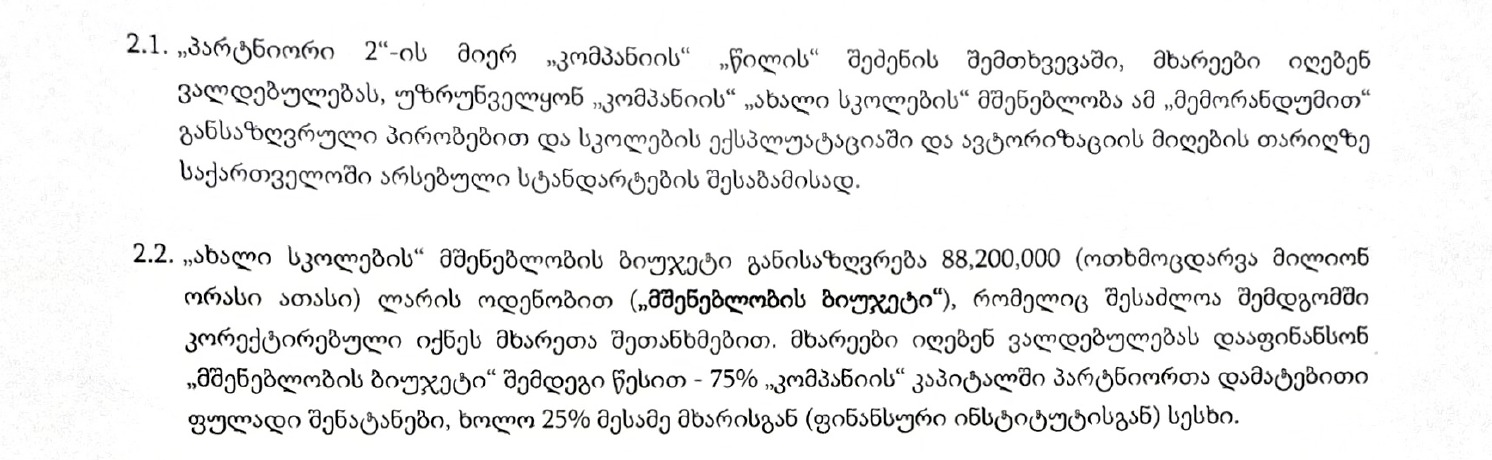
The Memorandum of Understanding sets out the agreed investment structure. It describes an investment programme for the development of the schools — not a simple share sale. The agreed investment programme totals GEL 88.2 million. This specific figure corresponds precisely to the Business Model, where the Okrokana / Tabakhmela land was valued at zero. The share transfer did not occur in isolation. The transfer of shares was directly linked to the investment commitments that Georgia Capital undertook as part of the transaction. We did not agree to transfer 70% control of the schools because we wanted to walk away. We agreed because Georgia Capital offered a long-term investment partnership — new campuses, improved infrastructure, and long-term investment. Without those commitments, there would have been no transaction. Georgia Capital cannot reduce the entire deal to one phrase — 'we paid GEL 30 million' — while ignoring the investment structure that induced the transfer.
3. The MOU Veto Clause: Protection Against Forced Contributions
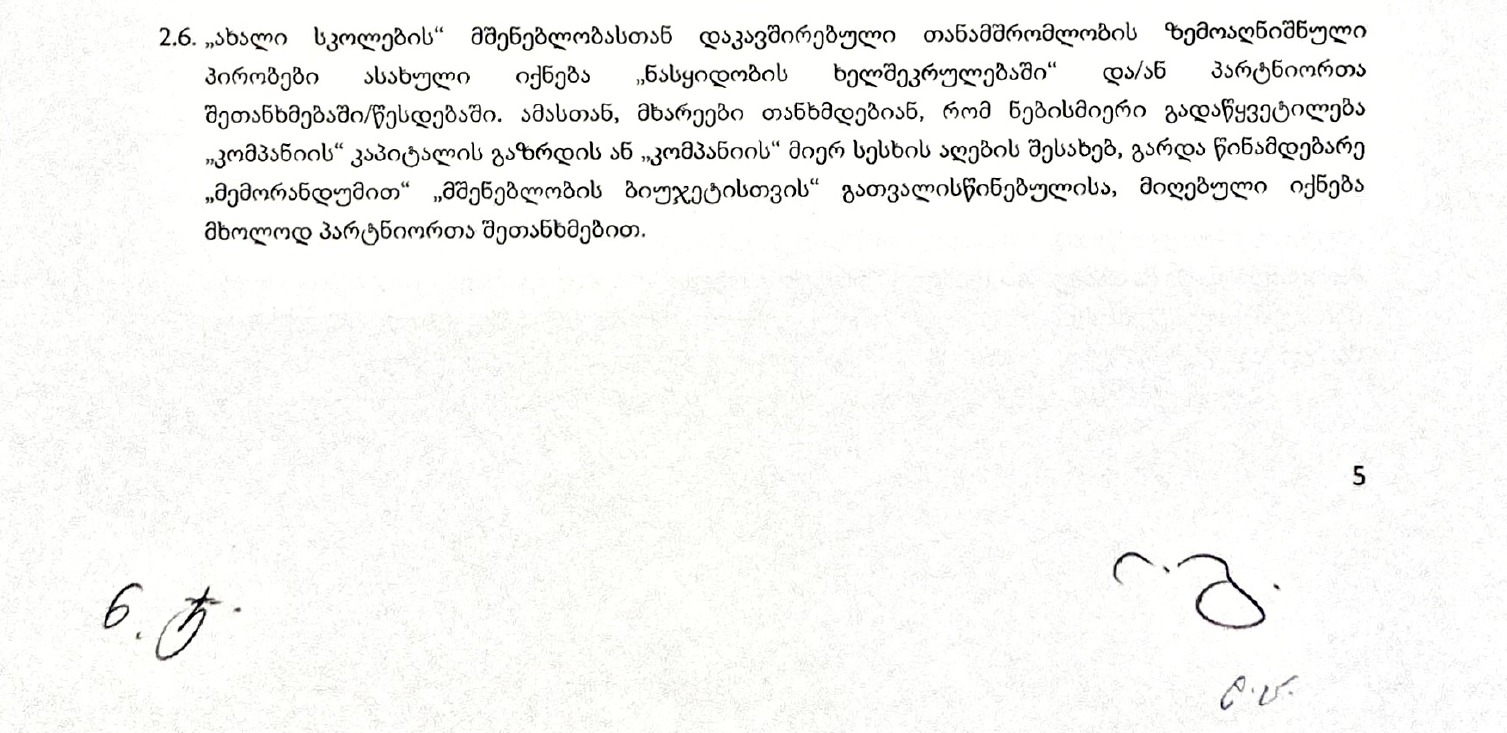
The MOU also contains a crucial protection clause. This clause protects my remaining 30% stake and requires my approval for any additional cash or asset contributions — including any land contributions — that fall outside the agreed investment structure.
This protection was essential. As the 30% shareholder, I could not allow Georgia Capital, as the 70% shareholder, to use its majority position to impose new contributions, inject assets at values it determined, or apply financial pressure to reduce my stake. The veto clause existed for exactly that reason.
This is why Georgia Capital's subsequent conduct regarding the Okrokana / Tabakhmela land is so revealing. If the land had already been agreed as a priced contribution — and if payment for it had already been agreed — then there would have been no need for a clause requiring my approval for additional contributions, including land contributions. But such a clause existed. Georgia Capital later attempted to do exactly what the clause protected against: to contribute the Okrokana / Tabakhmela land at a stated value and demand payment of my 30% share from me.
The veto clause proves that I never gave Georgia Capital a blank cheque to value the land later and demand payment from me. I agreed to nil value only. I never agreed to pay for their land.
4. The SPA: The MOU Was an Integral Part of the Transaction
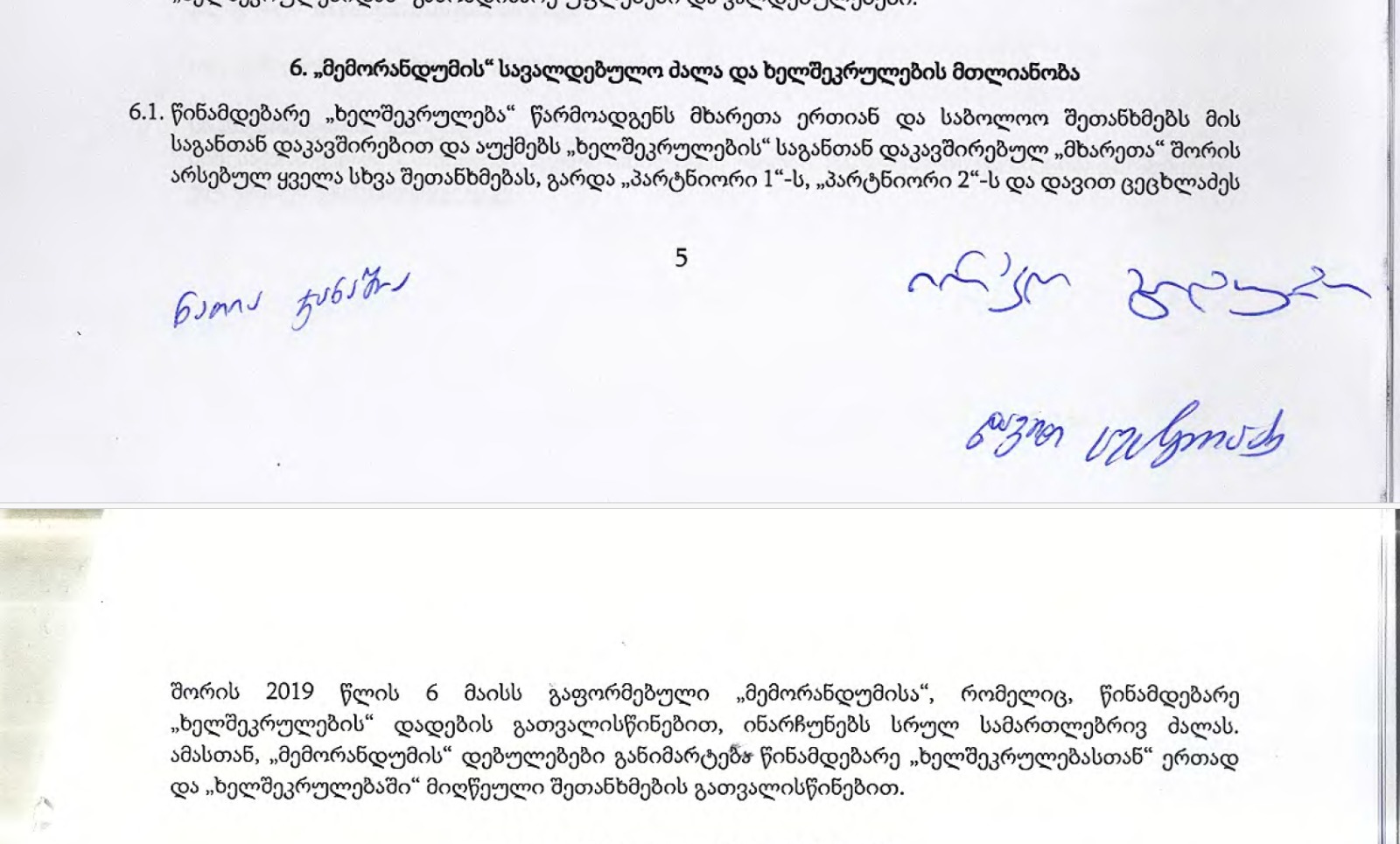
Georgia Capital now attempts to present the Share Purchase Agreement in isolation — to persuade the public that the entire transaction was simply a share sale and nothing more. But the Share Purchase Agreement itself defeats that argument. The SPA expressly provides that the MOU is an integral part of the transaction and retains full legal force. That means the SPA did not invalidate the MOU. That is the decisive point.
Georgia Capital cannot rely on the Share Purchase Agreement to acquire a 70% stake in the British-Georgian Academy and then present the matter as though the MOU had no connection to the transfer. It cannot take the benefit provided by the SPA and reject the obligations set out in the MOU. If the MOU had no connection to the share transfer, why does the Share Purchase Agreement provide that it is an integral part of the transaction?
The Questions Georgia Capital Cannot Answer
If this was merely a simple share sale, why were there three documents? If the Business Model did not matter, why was the GEL 88.2 million investment programme calculated from it? If the Okrokana / Tabakhmela land was not part of the deal at nil value, why was it valued at zero in the Business Model? If the MOU had no connection to the sale, why does the Share Purchase Agreement provide that it is an integral part of the transaction? And if we had already agreed to pay for the land, why did the MOU give us the right to block additional asset contributions?
These questions matter because they expose the falsehood in Georgia Capital's narrative — that our agreement was a simple sale and not an investment transaction. The agreement with Georgia Capital would not have been concluded without the investment commitments, including the nil-value land structure and the protections for our remaining 30% stake.
Georgia Capital's Court Argument About 'Zero' Does Not Hold
Georgia Capital now argues in court that the '0' shown against the Okrokana / Tabakhmela land in the January 2019 Business Model did not mean zero value — and that the land was not committed to the school at nil value. They attempt to present this figure as referring only to their own internal cost. That argument fails on the documents.
The January 2019 Business Model file was not titled 'Georgia Capital's cost estimate.' It was titled 'BGA/BIST Business Model' — and its contents confirm exactly that. The Business Model contains the schools' data: student numbers, campus sizes, tuition fees, operating costs, revenues, capital expenditures, and total investment requirements. These are school-level figures, not Georgia Capital's internal costs. The data is also presented on a whole-school basis, not as a percentage of Georgia Capital's possible statutory stake. If Georgia Capital had intended to show only its own proportionate costs, the Business Model would not reflect 100% of the schools' operational and financial data and investment requirements.
The three-campus model in the Business Model showed a total investment of GEL 118,544,986. When the Wyneth campus was subsequently removed from the plan, its capital expenditure of GEL 30,475,000 was deducted:
GEL 118,544,986 – GEL 30,475,000 = GEL 88,069,986
This figure corresponds to the approximately GEL 88.2 million investment programme in the MOU — the small difference explained only by currency fluctuation. This confirms that the GEL 88.2 million figure in the MOU was taken directly from the school's Business Model — the same Business Model in which the Okrokana / Tabakhmela land was valued at zero. If the value of the Okrokana land to the school had been USD 3.25 million, the total investment programme would not have been approximately GEL 88.2 million.
In summary, the Business Model clearly establishes that the value of the Okrokana land to the school is zero. It was on that basis that the investment programme was calculated, the MOU was agreed, and the share sale was concluded.
Conclusion: The SPA Did Not Erase the MOU. It Incorporated It.
Georgia Capital wants to reduce the entire 2019 transaction to one sentence: 'We paid GEL 30 million.' We, the founders, agreed to an entirely different transaction. The actual transaction was documented in the Business Model, the MOU, and the Share Purchase Agreement. Those documents show an investment structure — not a simple sale.
Georgia Capital cannot now change the deal and separate documents that were part of one transaction. It cannot use the Share Purchase Agreement to obtain control and then set aside the MOU when it becomes inconvenient. It cannot ignore the Business Model in which the land is valued at zero. And it cannot claim that we simply transferred the work of our lifetime and walked away.
We did not agree to a simple share sale. We agreed with Georgia Capital on an investment partnership, on nil-value land, and on protections for our remaining stake. We would never have agreed to transfer control of the British-Georgian Academy without the investment commitments that formed the basis of the transaction.